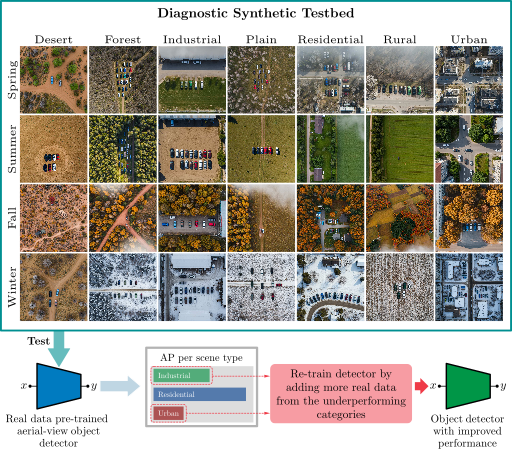
@inproceedings{ECCV2026_ModelDiagnostics,author={Panev, Stanislav and Jeon, Minhyek and Khindkar, Vaishnavi and Deshpande, Ahish and Melo, Celso De and Hu, Shuowen and Chakraborty, Shayok and Torre, Fernando De La},booktitle={19th European Conference on Computer Vision (ECCV)},title={{Diagnosing Aerial-View Object Detectors with Foundational Image Generative Models}},year={2026},volume={},number={},pages={},keywords={Aerial-view object detection;Synthetic data diagnostics;Generative image models;Text-to-image synthesis (Imagen 3);Remote sensing;Model robustness evaluation;},}
2025
ICIP
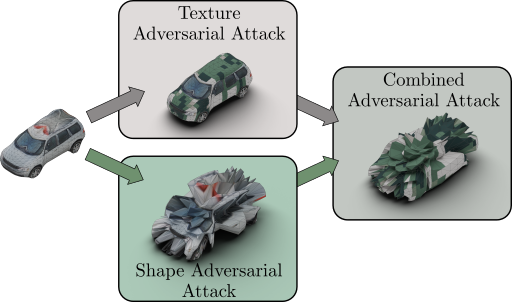
Texture- and Shape-Based Adversarial Attacks for Overhead Image Vehicle Detection
@inproceedings{11084759,author={Yeghiazaryan, Mikael and Namburu, Sai Abhishek Siddhartha and Kim, Emily and Panev, Stanislav and De Melo, Celso and De La Torre, Fernando and Hodgins, Jessica K.},booktitle={2025 IEEE International Conference on Image Processing (ICIP)},title={Texture- and Shape-Based Adversarial Attacks for Overhead Image Vehicle Detection},year={2025},volume={},number={},pages={2133-2138},keywords={Deep learning;Limiting;Shape;Image color analysis;Pipelines;Object detection;Detectors;Reproducibility of results;Reliability;Remote sensing;adversarial attacks;remote sensing;object detection},doi={10.1109/ICIP55913.2025.11084759},}
SPIE
Leveraging generative AI for cross-regional small object detection in satellite imagery
@inproceedings{10.1117/12.3054372,author={Qin, Zheyang and Panev, Stanislav and Melo, Celso De and Chakraborty, Shayok and Hodgins, Jessica and Torre, Fernando De La},title={{Leveraging generative AI for cross-regional small object detection in satellite imagery}},volume={13459},booktitle={Synthetic Data for Artificial Intelligence and Machine Learning: Tools, Techniques, and Applications III},editor={Manser, Kimberly E. and Howell, Christopher L. and Rao, Raghuveer M. and Melo, Celso De and Prussing, Keith F.},organization={International Society for Optics and Photonics},publisher={SPIE},pages={134590O},keywords={Generative AI, Diffusion Model, Synthetic Dataset, Object Detection, Vehicle Detection},year={2025},doi={10.1117/12.3054372},}
ICCV
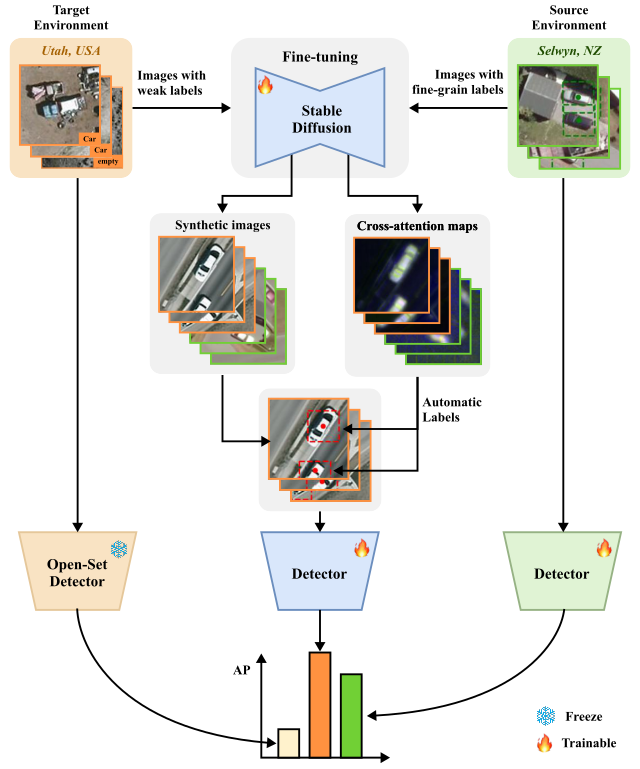
Adapting Vehicle Detectors for Aerial Imagery to Unseen Domains with Weak Supervision
@inproceedings{Fang_2025_ICCV,author={Fang, Xiao and Jeon, Minhyek and Qin, Zheyang and Panev, Stanislav and De Melo, Celso and Hu, Shuowen and Chakraborty, Shayok and De La Torre, Fernando},title={Adapting Vehicle Detectors for Aerial Imagery to Unseen Domains with Weak Supervision},booktitle={Proceedings of the IEEE/CVF International Conference on Computer Vision (ICCV)},month=oct,year={2025},pages={8088-8099},}
2024
WACV
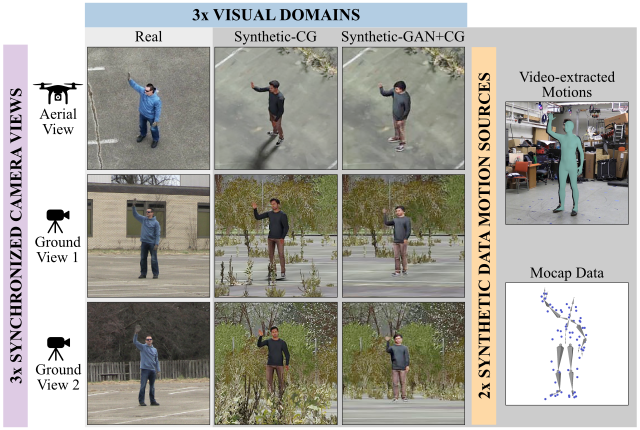
Exploring the Impact of Rendering Method and Motion Quality on Model Performance When Using Multi-View Synthetic Data for Action Recognition
@inproceedings{Panev_2024_WACV,author={Panev, Stanislav and Kim, Emily and Namburu, Sai Abhishek Si and Nikolova, Desislava and De Melo, Celso and De La Torre, Fernando and Hodgins, Jessica},title={Exploring the Impact of Rendering Method and Motion Quality on Model Performance When Using Multi-View Synthetic Data for Action Recognition},booktitle={Proceedings of the IEEE/CVF Winter Conference on Applications of Computer Vision (WACV)},month=jan,year={2024},pages={4592-4602},}
2020
MDPI Sensors
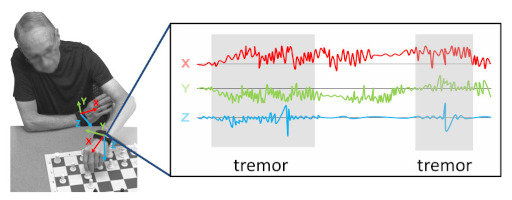
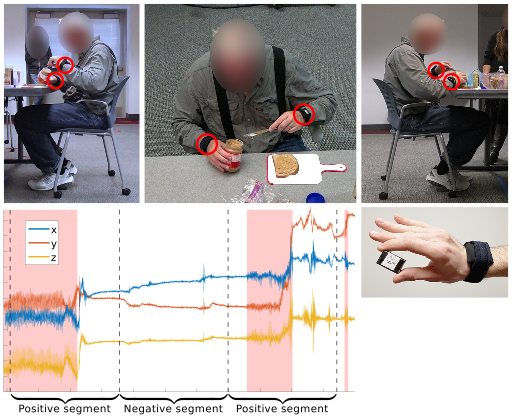
Parkinson’s Disease Tremor Detection in the Wild Using Wearable Accelerometers
Continuous in-home monitoring of Parkinson’s Disease (PD) symptoms might allow improvements in assessment of disease progression and treatment effects. As a first step towards this goal, we evaluate the feasibility of a wrist-worn wearable accelerometer system to detect PD tremor in the wild (uncontrolled scenarios). We evaluate the performance of several feature sets and classification algorithms for robust PD tremor detection in laboratory and wild settings. We report results for both laboratory data with accurate labels and wild data with weak labels. The best performance was obtained using a combination of a pre-processing module to extract information from the tremor spectrum (based on non-negative factorization) and a deep neural network for learning relevant features and detecting tremor segments. We show how the proposed method is able to predict patient self-report measures, and we propose a new metric for monitoring PD tremor (i.e., percentage of tremor over long periods of time), which may be easier to estimate the start and end time points of each tremor event while still providing clinically useful information.
@article{s20205817,author={San-Segundo, Rubén and Zhang, Ada and Cebulla, Alexander and Panev, Stanislav and Tabor, Griffin and Stebbins, Katelyn and Massa, Robyn E. and Whitford, Andrew and De La Torre, Fernando and Hodgins, Jessica},title={Parkinson’s Disease Tremor Detection in the Wild Using Wearable Accelerometers},journal={Sensors},volume={20},year={2020},number={20},article-number={5817},url={https://www.mdpi.com/1424-8220/20/20/5817},pubmedid={33066691},issn={1424-8220},doi={10.3390/s20205817},}
2019
ICCV
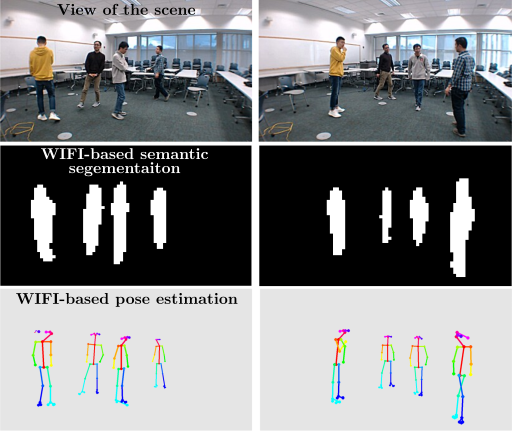
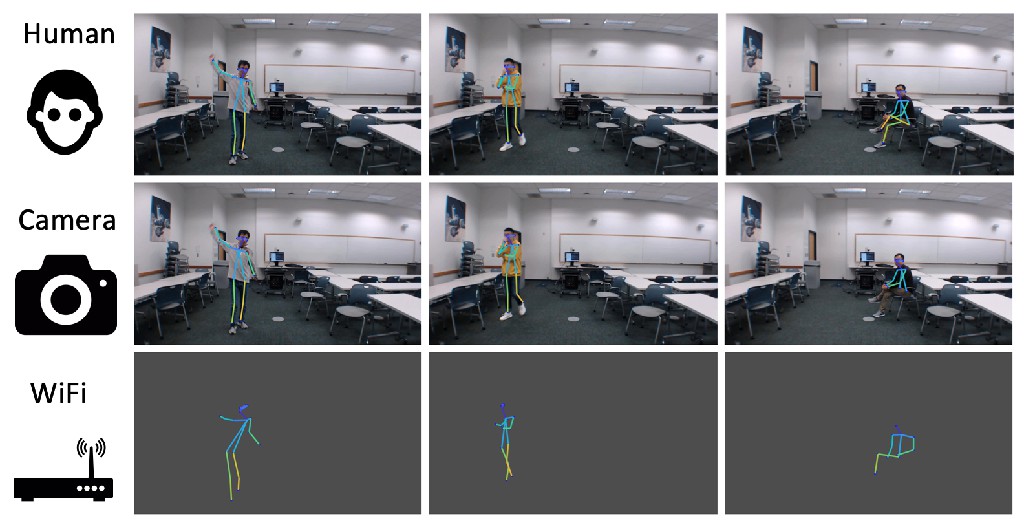
Person-in-WiFi: Fine-Grained Person Perception Using WiFi
@inproceedings{Wang_2019_ICCV,author={Wang, Fei and Zhou, Sanping and Panev, Stanislav and Han, Jinsong and Huang, Dong},title={Person-in-WiFi: Fine-Grained Person Perception Using WiFi},booktitle={Proceedings of the IEEE/CVF International Conference on Computer Vision (ICCV)},month=oct,year={2019},}
@misc{wang2019wifiestimatepersonpose,title={Can WiFi Estimate Person Pose?},author={Wang, Fei and Panev, Stanislav and Dai, Ziyi and Han, Jinsong and Huang, Dong},year={2019},archiveprefix={arXiv},primaryclass={cs.CV},url={https://arxiv.org/abs/1904.00277},}
T-ITS
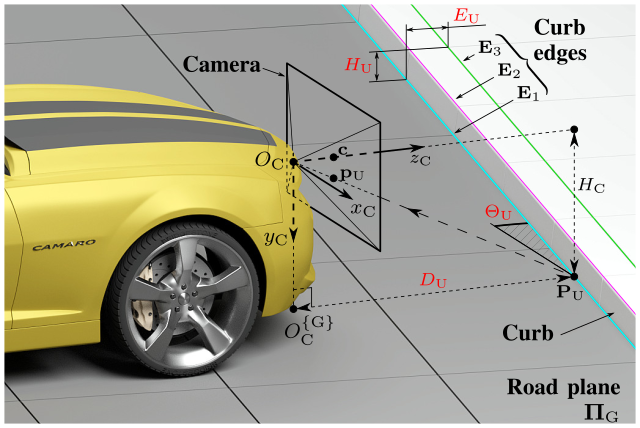
Road Curb Detection and Localization With Monocular Forward-View Vehicle Camera
@article{8532105,author={Panev, Stanislav and Vicente, Francisco and De La Torre, Fernando and Prinet, Véronique},journal={IEEE Transactions on Intelligent Transportation Systems},title={Road Curb Detection and Localization With Monocular Forward-View Vehicle Camera},year={2019},volume={20},number={9},pages={3568-3584},keywords={Three-dimensional displays;Cameras;Sensors;Laser radar;Image edge detection;Feature extraction;Roads;Curb detection;parking assistance;monocular camera;HOG;SVM;template fitting;tracking},doi={10.1109/TITS.2018.2878652},}
2018
IEEE/ACM CHASE
Automated Tremor Detection in Parkinson’s Disease Using Accelerometer Signals
Wearable sensor technology has the potential to transform the treatment of Parkinson’s Disease (PD) by providing objective analysis about the frequency and severity of symptoms in everyday life. However, many challenges remain to developing a system that can robustly distinguish PD motor symptoms from normal motion. Stronger feature sets may help to improve the detection accuracy of such a system. In this work, we explore several feature sets compared across two classification algorithms for PD tremor detection. We find that features automatically learned by a Convolutional Neural Network (CNN) lead to the best performance, although our handcrafted features are close behind. We also find that CNNs benefit from training on data decomposed into tremor and activity spectra as opposed to raw data.
@inproceedings{8648666,author={Zhang, Ada and San-Segundo, Rubén and Panev, Stanislav and Tabor, Griffin and Stebbins, Katelyn and Whitford, Andrew and De la Torre, Fernando and Hodgins, Jessica},booktitle={2018 IEEE/ACM International Conference on Connected Health: Applications, Systems and Engineering Technologies (CHASE)},title={Automated Tremor Detection in Parkinson's Disease Using Accelerometer Signals},year={2018},volume={},number={},pages={13-14},keywords={Parkinson's disease;Feature extraction;Accelerometers;Radio frequency;Classification algorithms;Deep learning;Standards;Parkinson's Disease;wearable sensors;mobile health;deep learning},doi={10.1145/3278576.3278582},}
2017
EMBC
Weakly-supervised learning for Parkinson’s Disease tremor detection
@inproceedings{8036782,author={Zhang, Ada and Cebulla, Alexander and Panev, Stanislav and Hodgins, Jessica and De La Torre, Fernando},booktitle={2017 39th Annual International Conference of the IEEE Engineering in Medicine and Biology Society (EMBC)},title={Weakly-supervised learning for Parkinson's Disease tremor detection},year={2017},volume={},number={},pages={143-147},keywords={Approximation algorithms;Standards;Monitoring;Accelerometers;Data collection;Parkinson's disease},doi={10.1109/EMBC.2017.8036782},}